Showing posts with label East London. Show all posts

Monday, August 6, 2012

Day 9 –Two High Schools in East London


Today’s activities began at the East London campus of the University of Fort Hare.


This university is known as the place where many of South Africa’s freedom fighters (Nelson Mandela, Oliver Tambo, Chris Hani, Robert Sobukwe) did their post-secondary studies. We met the Director of Fort Hare’s International Affairs, Arthur Johnson. Arthur arranged for us to visit two secondary schools in East London, then return to the University to meet with some education faculty.

We drove only 10 minutes from the East London campus to our first stop, but the contrast between the urban campus setting and the informal settlements was very distinct:


We arrived in the township of Duncan Village, where, just outside our first school, we saw this large monument:


Some digging online uncovered that this monument was a memorial to a 1985 event in this village, known as the Duncan Village Massacre, when 32 people lost their lives in a battle with police. The statute portrays a Xhosa warrior ready for battle.

After that unique introduction to Duncan Village, we entered the gates of the Kusile High School and were introduced to Principal F.H. Gayiza:

Kusile High School

Kusile Principal F.H. Gayiza

Principal Gayiza, who has been running this school since 1996, spent a good deal of time with our group discussing the structure and operation of Kusile. He explained that the school had a staff of 46 teachers, including student teachers from Walter Sisulu University and social workers from Fort Hare. His staff is responsible for 1228 students and he kindly shared the enrollment figures for the five grades (8 through 12) in his school:


Grade:
8
9
10
11
12
Enrollment: 243 281 341 248 115

We asked him about the large jump in grade 10 enrollment, and we heard (again) about how a passing score in grade 10 was heavily weighted by the end-of-year exams. This shift resulted in a large failure rate for grade 10 students and a high repeat rate for that grade. This confirmed what we had heard just two days ago during our visit to Mandela Metropolitan University (read that excerpt here).

Principal Gayiza seemed open to questions, so we asked him what he thought were the biggest challenges to the Kusile School. He paused for a moment, then told us that security and the state of the facility were probably his two biggest issues. He went on to explain that, although the school served the surrounding community, people from the informal settlements continue to vandalize the school. He cited instances where fences were cut and water taken in the middle of the might. This has caused the school to hire a guard to patrol the perimeter during off-hours. His facility issues were nothing that unusual, in that the number and size of the classes required too many students to be places in one room (e.g. the grade 8 and 9 class size was about 60 students). He did say, however, that “the government is doing its best”.

We took a quick tour of the ground floor and saw students during their morning break, plaing ball and enjoying the fine ‘winter’ weather (it was about 60 F!)


Kusile students eager to get their picture taken!

We finished our tour and thanked the Principal for his time and the opportunity to learn about his school.

Our next stop was another high school, only one mile down the road. In just a few minutes, we arrived at Lumko High School and met with their principal, W. M. Links.

Principal Links, a very soft-spoken man, has been in charge of Lumko for ten years. He told us that the 20 staff members at Lumko were responsible for 1000 students – about double the staff-to-student ratio that was present at Kusile. Lumko was a no-fee school, so students came from as far as 10 miles away to attend. Principal Links pointed out that about 80% of the school’s parents were uneducated, so the burden of education fell squarely on his staff. Despite this, Lumko was proud to show an 85% pass rate in the compulsory (state) exams.

The school day here concentrated on course content, with school running from 7am to 2:30 pm, and a compulsory session that ran from 2:30 to 6pm! Most staff were involved in this extended session, providing a staggering 22 more hours of instruction each week! There were no sports at Lumko, despite a field just beyond their classroom buildings. Principal Links explained that the school could not afford the fee required by the town to use the field.

Infrastructure was this school’s number one concern. With so many students and only a few classrooms, class size was an ongoing issue. We saw a History class for 62 grade 11 students:
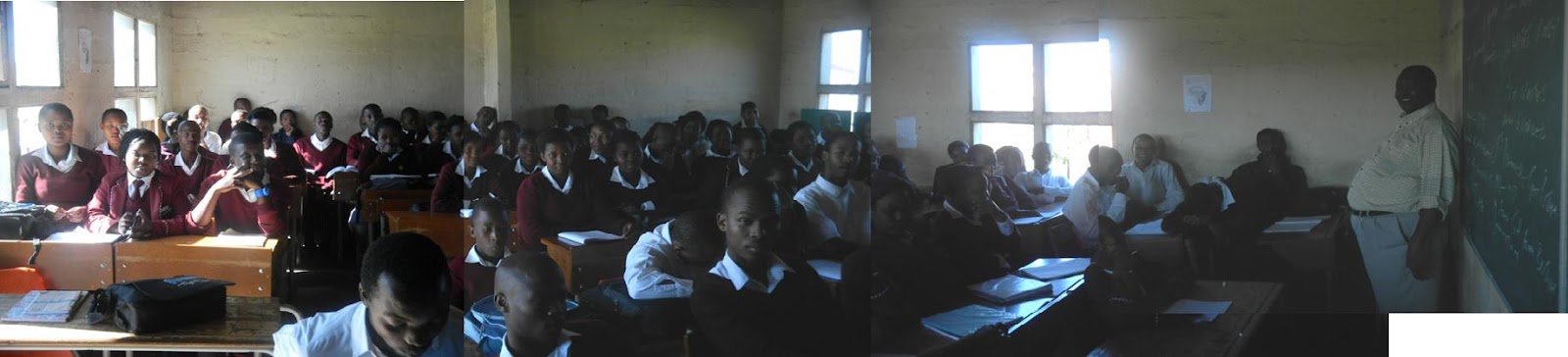
(Sorry, my composite shot missed a section of the back wall – there are more kids not shown!!) 

and a Cultures class that held 72 grade 8 students:


In both classes, believe it or not, the instructors seemed to genuinely enjoy what they were doing and the students seemed well-behaved.

When we asked about the possibility of more space or more classes, one of the staff spoke to us about plans and promises for an expanded site, but that nothing had come to pass. The school had even drafted its own plan for what type of site they could use, and the local government had gone so far as to make a promise to start building – but that was several years ago. In the meantime, the Lumko staff continues to do their work and provide an education for as many as they can handle.

Saturday, August 4, 2012

Day 8 (cont’d) – Hospice Centers

When our visit at the Barnes School was over, Geoff took us on a visit to two hospice centers that he has partnerships with.  From the Barnes School, we drove about 12 miles southwest through East London and arrived at our first stop, the Curt Warmberg Haven and Wellness Centre

Our group outside the Wellness Centre
Here, we were given a tour of the facility, where we were told that the center does much more than just HIV/AIDS care. Over 200 children are fed daily – directly from the kitchen of this facility. This is accomplished with just 22 staff members. The Warmberg Center also collects clothes and materials needed for young children and gives them to families in need. 


The Centre's Educare Facility
The staff accepted our group’s donation of sheets and toiletries. In fact, rather than just saying Thank You, the staff showed us their appreciation by singing us a hymn of joy that was quite moving.

Our second stop, not very far away, was the Good Samaritan Child & Youth Centre. Here we met Pastor Mike du Plessis, a long-time friend of Geoff’s. Mike told us that this center started in 2006 and currently provides on-site care for 14 full-time patients who are living with HIV/AIDS. They also care for about 300 patients living in the surrounding areas, as well as 60 children from their patients’ families. As Mike said, “We are an advocate for kids when their adults can’t be there for them.” Mike accepted our group’s donations of toiletries and bed linens and told us these items would definitely be put to good use.
Our group with Pastor Mike

Thursday, August 2, 2012

Day 8 – The A.W. Barnes Primary School


Our first full day in East London started with a visit to the A.W. Barnes Primary School. (In South Africa, primary schools include grades K through 7). When we arrived, we were greeted by Geoff Gamiet, their smiling, but intense principal.


This was the first day back for students following a break, so we arrived while they were in the middle of a school-wide assembly. It was quite a sight to see hundreds of students smiling and engaged in this meeting. Their chorus teacher led them in an amazing song. I was so stunned by their voices, I listened to most of their song before I had the presence of mind to record the last piece of it:


After the assembly, we met with Geoff, who gave us some background on himself and the school. Geoff told us that he started here as a teacher in 1977 and rose to become principal. The Barnes School is known as an outstanding school by the local community. Its reputation has made it a very over-enrolled school, with over 100 students across eight grades.

Geoff commented that they are so over-enrolled they had to turn away over 200 applicants this year. He related how parents are resorting to innovative ways to get their children into the Barnes. One family, for example, simply dressed their child in the school uniform and had them show up for school and follow the other kids into the building!

Staffing has become an issue at the school, with Geoff explaining that retiring teachers are not always replaced when they leave. This was the case last year, when three teachers retired, but the school received no replacements. It will be an issue again this year, when three more staff will retire. These staffing shortfalls translate into big class sizes, with most classes containing at least 35 students.

Geoff’s staff arranged a very busy day for us, as each member of our group was placed in a range of classrooms to observe and lend a hand. We started with a tour of some areas in the school. We visited a room where women created the school uniforms by hand and made them available for students. We also visited their Art Room, where I was impressed with the unbelievable work generated by the students (such as the piece below, from a 6th grader):

An Expression of My Culture by David Mqgelo, Grade 6 


By 10 am, we were on our way to our classroom visits. I began with a grade 7 class of 35 students:


Here, Mr. Benet conducted a nice Language Arts lesson, where students worked in groups to analyze a story about ‘Honey Queens’. They first had to figure out any unknown words, then there was a class review of the story. The students reminded me exactly of my class at home. Some students got right to work, some needed prompting… and a few spent a good five minutes searching for a pencil!

One thing that did NOT remind me of my class back home was the way students greeted visitors to their classroom. In my school, most visitors get a cursory intro by the teacher, students grunt or nod – then we go back to our lesson. Here, in each classroom I entered, the entire class stood up! The teacher introduced me (in my case, I was “Mr. John”), and every student – in unison – said “How are you today Mr. John? We are doing fine.” At this point, they wait, expecting an answer to their question! I must say, it caught me by surprise, but I was able to answer “I am doing fine. Thank You.”, at which point, they all sat down. It was unexpected, but I thought it was quite a bit more personal that the way we do things back home.

Following the Language Arts class, the Barnes staff had a 20-minute break where aids supervised the students while the entire staff met in the teachers’ room. This initially seemed odd to me (a mandatory break?), but Geoff explained that it was a way to have the staff interact with one another at least once a day – and it served as a time when school-wide information could be communicated to everyone at once. A simple, but great idea!

During this break, I asked Geoff about school fees at the Barnes. He told us that the Barnes asks for about 1000 Rand per year in school fees (or about $83/month). He put that into context, explaining that a typical school outside the township area might have fees as high as R1800 per MONTH! While he is aware that many families struggle to come up with the fee for his school, it doesn’t excuse them from all obligations. I heard one teacher tell a student to ‘bring taxi fare’ tomorrow, because he had to stay after school for misbehaving. (Because it gets dark early during this time of year, after-school students take transportation home). I asked what happened if a student failed to bring in this money, and was told that it was not a problem, as they usually did.

At 11am, I saw a lesson on reading skills, where students in a grade 5 class read a short passage on AIDS and constructed a ‘Fact/Fallacy’ chart, based on what they read. This class had 50 students in one room. The last class I observed was a grade 4 class containing 46 students:

(Sorry for the double shot of the teacher – she moved in between my two pictures!) 

In this class, students filled out a chart on different types of animal names, whether male, female, or baby. The chart had a few of the boxes filled in, so students understood what was expected of them. They seemed to enjoy finding this information from a sheet they had in their notebooks and worked well together.

After these visits, we had an excellent lunch with Geoff and his staff and some board members. We spoke to a few young women from Germany who spent the last year at the school as volunteers, assisting wherever they might be needed. One of the women was so impressed with what she experienced that she convinced her brother to come from Germany and volunteer!

Over 5 hours later, it was time for us to be on our way.  We thanked Geoff for his hospitality and for the opportunity to interact so much with the staff and students.

Lou Ann Griswold, Diane Moore, Susan Merrill, A.W. Barnes Principal Geoff Gamiet, Debbie Chase, Susan Reynolds, John Padula

Make sure I give credit to Fund For Teachers!!


I really can’t say enough good things about the work going on at the Barnes School. They get the job done, day in and day out. This visit was, for me, another instance of how a dynamic leader with a vision and a dedicated staff can make all the difference. The Barnes School, like Kliptown and Ubuntu, are models of success!